
What Are Project Sign Boards Used for in Construction?
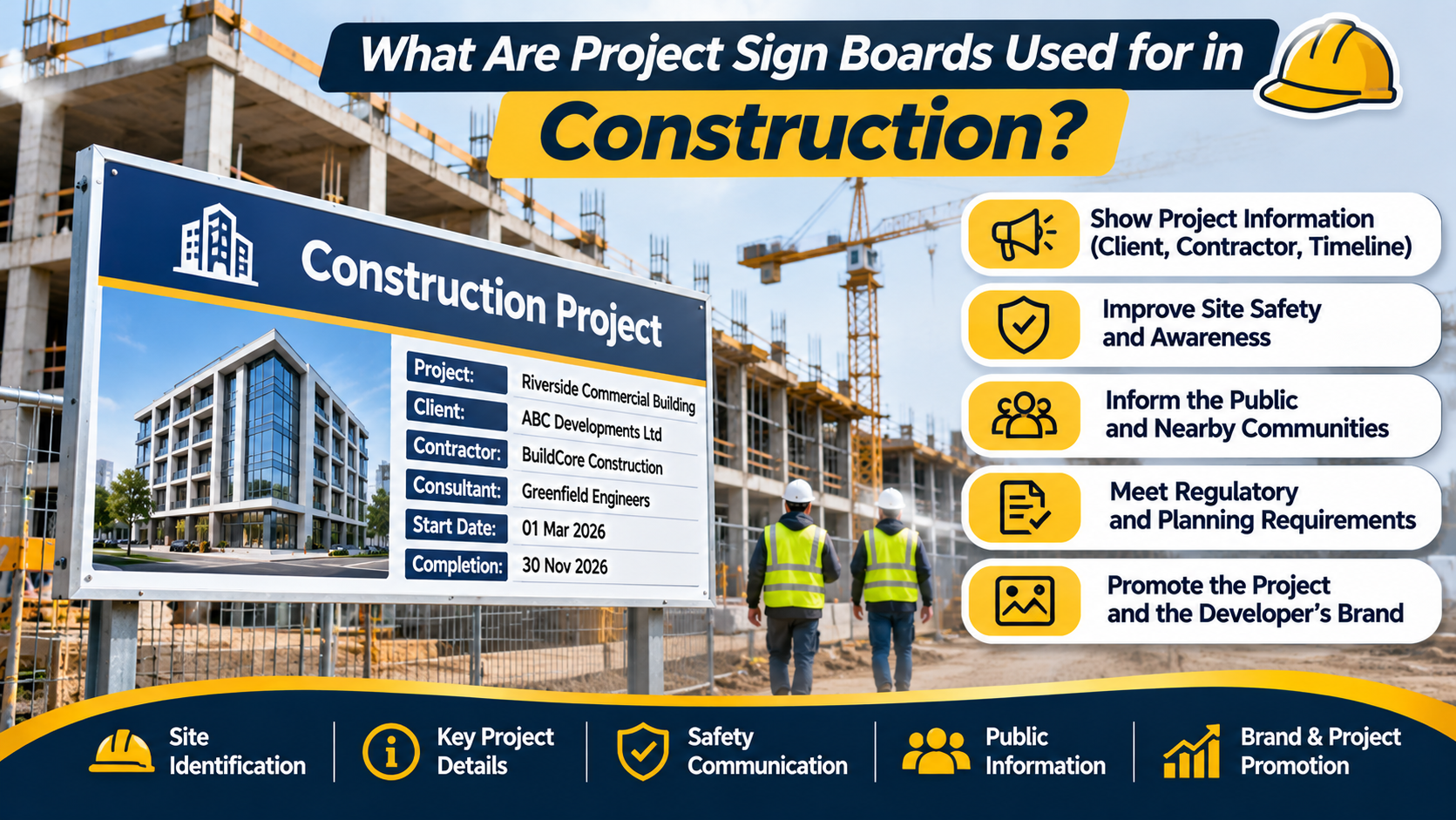
Walk past a construction site in the UAE and you will often see a large board displaying the development name, contractor details, consultant information and other project particulars. This is a project sign board. It does more than identify a building site: it communicates essential project information, presents the organisations involved and gives the development a recognisable identity.
For construction companies, developers and contractors, choosing the right construction sign board is an important part of preparing a site. Its design, printed information, materials, visibility and supporting structure all influence how effectively it serves its purpose.
But what exactly are project sign boards used for, what information should they display, and how do you select a suitable option? This guide explains their main functions, common features and practical considerations, particularly for construction projects across the UAE.
What Is a Project Sign Board?
A project sign board is an outdoor information display installed at or near a construction site. It identifies the development and communicates relevant details about the project, including the developer, main contractor, consultant and permit information where required.
These boards are commonly positioned near site entrances, boundary fencing or other visible areas where visitors, workers and passers-by can see them.
Unlike ordinary advertising signs, construction project boards have a specific informational purpose. They help people identify the development and understand which organisations are responsible for the work.
A professionally prepared sign board may also include a building illustration, company logos, project branding and other details specified by the client or relevant authority.
What Are Project Sign Boards Used for in Construction?
Project sign boards serve several purposes throughout the construction process. Their value extends beyond displaying a project name.
1. Identifying the Construction Project
One of their main functions is to identify the development taking place at a particular location.
A clearly displayed board can communicate:
-
Project or development name.
-
Building or site identification.
-
Plot or reference number, where applicable.
-
Developer or property owner's name.
-
Project illustration or architectural visual.
-
Relevant project identification details.
This information helps distinguish one development from another, particularly in areas where multiple construction projects are taking place.
For example, a residential tower, commercial building and infrastructure development may be located within the same construction zone. Separate project sign boards help identify each site.
2. Displaying Contractor and Consultant Information
Construction projects involve several organisations working together. These may include developers, engineering consultants, main contractors and subcontractors.
A project sign board provides a visible place to display the names and details of the responsible parties.
Depending on the project requirements, the board may include:
-
Developer details.
-
Main contractor information.
-
Engineering consultant details.
-
Architect or design consultant.
-
Subcontractor names, where required.
-
Relevant company branding.
Displaying this information makes the project team easier to identify and provides a clear reference for people who need to understand who is involved in the development.
3. Presenting Permit and Approval Details
Some construction project boards are required to display permit numbers and other official project information.
The exact information, layout and display requirements depend on the relevant municipality, authority, development area or project contract.
Including the correct details helps ensure that the board reflects the approved project information rather than displaying incomplete or inconsistent particulars.
Before printing, contractors should confirm the required wording, reference numbers and format with the project consultant or responsible authority.
4. Improving Construction Site Visibility
A construction site can be difficult to identify, particularly when it is located along a busy road or within a large development area.
A suitably positioned outdoor sign board makes the project more recognisable to visitors, delivery personnel, contractors and people passing the site.
Visibility depends on several factors:
-
Board dimensions.
-
Letter and logo size.
-
Contrast between text and background.
-
Printing quality.
-
Installation height.
-
Viewing distance and surrounding obstructions.
For example, a board positioned behind parked vehicles or hidden by temporary site equipment may not communicate its information effectively. Positioning should therefore be considered during site planning.
5. Strengthening Project Branding
Construction signage also provides an opportunity to present the identity of a development.
A board can display the developer's logo, project name, architectural rendering, brand colours and other approved visual elements. This creates a consistent presentation at the construction site.
For property developers, this can be particularly relevant when promoting residential communities, commercial buildings, hotels and large infrastructure developments.
A carefully arranged layout makes the project information easier to recognise while keeping the branding and essential details visually organised.
6. Supporting Site Communication
Project sign boards can act as a reference point for people approaching a construction site.
They help visitors identify the development and understand which organisations are associated with it. However, a project information board should not replace dedicated safety signage.
Hazard warnings, mandatory PPE instructions, emergency contacts, restricted-area notices and traffic directions should be displayed on suitable safety and operational signs at the relevant locations.
Keeping project identification separate from safety instructions helps prevent important warnings from becoming difficult to notice.
What Information Should a Construction Sign Board Display?
The information displayed depends on the type of development and the requirements set by the relevant authority or project team.
A typical construction sign board may contain the following:
|
Information |
Purpose |
|
Project name |
Identifies the development |
|
Developer details |
Names the property owner or developer |
|
Main contractor |
Identifies the organisation responsible for construction |
|
Consultant information |
Displays the appointed consultant's details |
|
Permit number |
Provides the relevant project reference |
|
Project illustration |
Shows the proposed building or development |
|
Company logos |
Presents the organisations' identities |
|
Additional project details |
Includes information required by the client or authority |
Not every project requires every item. The final design should follow the approved project information and applicable display requirements.
For UAE projects, it is particularly important to confirm whether Arabic and English information is required and whether the relevant authority has provided a specific layout or template.
Common Types of Construction Sign Boards
Different construction environments require different signage formats. The right option depends on the site layout, available space, viewing distance and information that needs to be displayed.
1. Main Project Information Boards
<text emphasis="bold">Main project information boards</text> are generally placed near construction entrances or other prominent locations.
They display the development name, project team details, permit information and other important particulars. Some designs also feature an architectural rendering to show the proposed appearance of the finished building.
<AsyncImage query="large construction project information signboard outdoor building development site UAE" aspectRatio="16:9" width="100%"/>
2. Contractor and Consultant Boards
These boards identify the organisations involved in a construction project. They may display individual company names, logos and their respective roles.
They are useful on larger developments where multiple contractors and consultants are working on the same site.
3. Site Safety Information Boards
Safety boards communicate health and safety information to workers and visitors. Their content may include emergency contact details, PPE requirements, safety performance information and site-specific instructions.
They should be positioned where the relevant information can be seen by the intended audience.
4. Directional and Site Identification Signs
Directional signs help people locate specific areas within a construction site, such as site offices, entrances, delivery points and designated access routes.
These signs serve a different purpose from the main project information board and should be designed around the movement of people and vehicles.
5. Fence Branding and Construction Hoarding Graphics
Printed branding on construction fencing or hoarding can display project visuals, developer information and promotional graphics along the site boundary.
This format is particularly useful for developments with long perimeter boundaries where a single information board may not provide enough space for the desired presentation.
Which Materials Are Used to Manufacture Project Sign Boards?
Material selection affects the appearance, durability and structural requirements of an outdoor sign board. Construction sites are exposed to sunlight, dust, wind and changing weather conditions, so the board must be suitable for its installation environment.
Common material options include:
ACP Panels
Aluminium Composite Panels (ACP) are used for outdoor signage because they provide a relatively smooth surface for printed graphics and project information.
They are commonly selected for boards that require a clean finish and a structured appearance.
Galvanised Steel
Galvanised steel is commonly used for support frames and certain signage applications. Its protective zinc coating helps resist corrosion, making it suitable for outdoor structural use when correctly specified.
Powder-Coated Steel Structures
Steel support structures may receive a powder-coated finish to provide an additional protective layer and a consistent appearance.
The frame should be designed according to the board's dimensions, installation method and expected environmental loads.
Reflective Vinyl and UV-Resistant Printing
Reflective vinyl can improve the visibility of selected graphics, while UV-resistant printing is used to help maintain printed colours during outdoor exposure.
The appropriate printing method depends on the board's design, viewing conditions and expected service environment.
What Makes a Project Sign Board Suitable for Outdoor Construction Sites?
A sign board installed outdoors needs more consideration than a display intended for an indoor environment.
Before approving a design, construction companies should review these practical factors:
Weather suitability: Select materials and finishes appropriate for prolonged exposure to sunlight, dust and moisture.
Readable information: Use clear typography, suitable text sizes and sufficient contrast so that essential details remain easy to read.
Structural stability: The frame, base plates, anchor bolts and foundations should be designed according to the board's size, height, location and wind exposure.
Correct positioning: Install the board where it can be seen without obstructing entrances, vehicle movement or site operations.
Printing quality: Choose suitable printing and finishing methods to maintain the clarity of project details and branding.
Accurate content: Verify names, permit references, logos and other project information before production.
A visually attractive board is not enough if its information is difficult to read or its support structure is unsuitable for the installation location.
How to Choose the Right Construction Sign Board for Your Project
Selecting the right board starts with understanding the site's actual requirements rather than choosing a design based only on appearance.
Follow these steps when planning a project sign board:
-
Identify the purpose: Decide whether the board will display project information, contractor details, branding or a combination of these.
-
Confirm the required content: Obtain the approved project details, company names and permit information.
-
Check the site location: Consider the viewing distance, available space, surrounding structures and access routes.
-
Select suitable materials: Choose the panel, printing method and support structure according to the outdoor environment.
-
Approve the design: Check spelling, logos, layout, colours and language requirements before production.
-
Plan installation: Confirm the fixing arrangement, foundation requirements and installation position.
-
Inspect the finished board: Check the printed information, alignment, structural stability and visibility after installation.
Following these steps helps avoid common problems such as incorrect project details, unsuitable dimensions and poor placement.
Project Sign Board Solutions by Vertex Fence in the UAE
Construction companies and developers need signage that communicates project details clearly and remains suitable for outdoor installation. Vertex Fencing & Steel Ind. LLC provides customised construction project sign boards for construction sites, infrastructure developments, commercial projects and industrial facilities across the UAE.
Its project signage solutions include several features designed around project requirements:
-
ACP panels and galvanised steel components.
-
Heavy-duty steel support structures.
-
UV-resistant printing and reflective vinyl options.
-
Custom board dimensions and branding.
-
Single-sided and double-sided designs.
-
Base plates and anchor bolt support systems.
-
Optional delivery and installation support.
Vertex Fence also offers consultation, design, fabrication and printing as part of its signage process. Customers can discuss their project dimensions, branding requirements and display specifications before production.
Whether you need a project information board for a residential development, a branded display for a commercial building or signage for an infrastructure project, the design should reflect the site's requirements and approved project information.
Explore Vertex Fence's Project Sign Boards to learn more about its construction signage solutions across the UAE.
Frequently Asked Questions
1. What is the main purpose of a project sign board?
A project sign board identifies a construction development and displays important information, such as the project name, developer, contractor, consultant and relevant permit details. It can also present project branding and architectural visuals.
2. What should be written on a construction sign board?
The content may include the project name, plot or reference number, developer details, consultant information, main contractor details, permit number and project illustration. The exact requirements depend on the relevant authority and project specifications.
3. Are project sign boards mandatory in the UAE?
Construction signage requirements vary according to the location, municipality, development authority and project conditions. Contractors should confirm the required board content, dimensions and layout with the responsible authority or appointed consultant before installation.
4. Which material is suitable for outdoor project sign boards?
ACP panels are commonly used for signage faces, while galvanised steel can be used for supporting structures. The final material selection should consider weather exposure, board dimensions, printing requirements and structural design.
5. What is the difference between a project sign board and a safety sign?
A project sign board identifies the development and displays project-related information. A safety sign communicates hazards, mandatory precautions, prohibited activities or emergency instructions. Both have different functions and should be positioned appropriately.
6. Can project sign boards be customised?
Yes. Project sign boards can be customised according to required dimensions, layouts, branding, printing finishes, languages and support structures. The final design should also follow the applicable project and authority specifications.
7. Who needs project sign boards?
Property developers, construction companies, main contractors, infrastructure contractors and industrial project managers may need project sign boards to identify their developments and display relevant project information.
Final Thoughts
Project sign boards play an important role in construction by identifying developments, presenting contractor and consultant details, displaying relevant permit information and supporting project branding. Their effectiveness depends on more than the printed design. Material selection, readability, correct information, structural support and installation position all matter.
For construction projects in the UAE, confirming the applicable signage requirements before fabrication is equally important. A properly planned construction sign board provides a clear project identity and presents essential information in a suitable outdoor format.
Vertex Fence offers customised project signboard solutions for developers, contractors and businesses looking for construction signage across the UAE.
 Dutch
 English
 Arabic
 French
 Spanish
 Portuguese
 Deutsch
 Turkish
 Italiano
 Russian
 Romaian
 Portuguese (Brazil)
 Greek